“Rejuran before and after” is one of the most searched phrases about this treatment in Australia. That tells you something useful: people want to know what actually happens, not what a brochure says.
We are going to answer that, but not with a wall of photographs. There are good reasons for that, which we explain below, and they are worth knowing before you judge any gallery you have been scrolling through.
What you get below is the plain version instead. When change shows up, how many sessions are typical, how long it tends to hold, what the downtime is actually like, and where the published evidence runs out.
The short version
When will I see something? Texture and hydration can start to shift at about the two week mark for some people. The collagen side of it is slower, and it usually keeps developing for three to six months after you finish the course.
How many sessions? Usually three, spaced two to four weeks apart depending on the formulation. Scarring may need more.
How long does it last? Polynucleotides are broken down by the body, so the effect is not permanent. Maintenance is commonly discussed at six to twelve months, and the interval varies considerably between individuals.
What is the downtime? Small bumps at each injection point that usually settle within 24 hours. Bruising can take up to a week.
Does it work? The published evidence supports skin quality outcomes such as wrinkles, texture and elasticity. The studies are small and varied, and it is not a substitute for treatments that do something structurally different.
Why we do not show you a gallery of before and after photos
Australian rules on this changed in September 2025, and they are stricter than most people realise.
Under the Ahpra guidelines for advertising higher risk non-surgical cosmetic procedures, before and after images must be of actual patients who had that procedure performed by that practitioner. Not supplier images. Not stock photography. They must not be edited, filtered, retouched or grey-scaled. They must be as similar as possible in lighting, camera angle, background, framing, exposure, posture, clothing and makeup. The before image, or a combined image, must be the more prominent one, because leading with the after creates unrealistic expectations. The after image should state how long after treatment it was taken. And every image needs a warning that the outcome shown is only relevant to that patient.
Meeting all of that properly takes work, and it is a fair standard to hold any clinic to, including us.
The more useful thing we can give you is the ability to judge any photo you come across, including ours.
How to read a before and after photo
Run through this list. It takes twenty seconds and it will change what you think of half the images you have saved.
Is the lighting identical? Softer, more diffuse light in the after shot flatters skin texture enormously. Under-eye shadows in particular are mostly a lighting phenomenon. If the before was shot under a downlight and the after under a ring light, you are looking at photography.
Is the head at the same angle? Drop the chin and the nasolabial folds and under-eye shadows get deeper. Lift it and they soften. A few degrees of tilt can do more to a photo than the treatment did to the face.
Is the expression the same? If there is a slight squint in the before and none in the after, you are comparing two expressions rather than two skins.
Is there makeup in one and not the other? Concealer under the eyes is the obvious one. So is a change in foundation coverage.
How long after treatment was the after photo taken? With a collagen-stimulating treatment this is critical. A photo taken at two weeks and a photo taken at four months are showing different biological processes. If the timing is not stated, you cannot interpret it.
Was anything else done? People rarely have one treatment in isolation. If the caption does not say what else was involved in that period, including skincare and sun behaviour, the attribution is guesswork.
Does the image look processed? Smoothed pores, uniform skin tone and absent fine texture usually mean a filter rather than a treatment.
What “results” means with a treatment like this
Rejuran® is not a filler. It does not add volume, so there is no before-and-after moment on the day. It is a polynucleotide gel placed into the dermis with the aim of supporting the skin’s own repair processes, which means the change is a change in skin quality over months.
That has two consequences worth being clear about.
The changes tend to be subtle and cumulative rather than dramatic. People often describe skin that looks less crepey and holds makeup differently before they can point to a specific line that has gone.
And the change is harder to photograph than a volume change, precisely because it is a texture and quality change. This is one reason honest before and after images for polynucleotide treatments are less striking than filler galleries. That is not a failing of the treatment. It is what the treatment is.
A realistic timeline
Everyone is different, and this is a general pattern rather than a schedule you should hold us to.
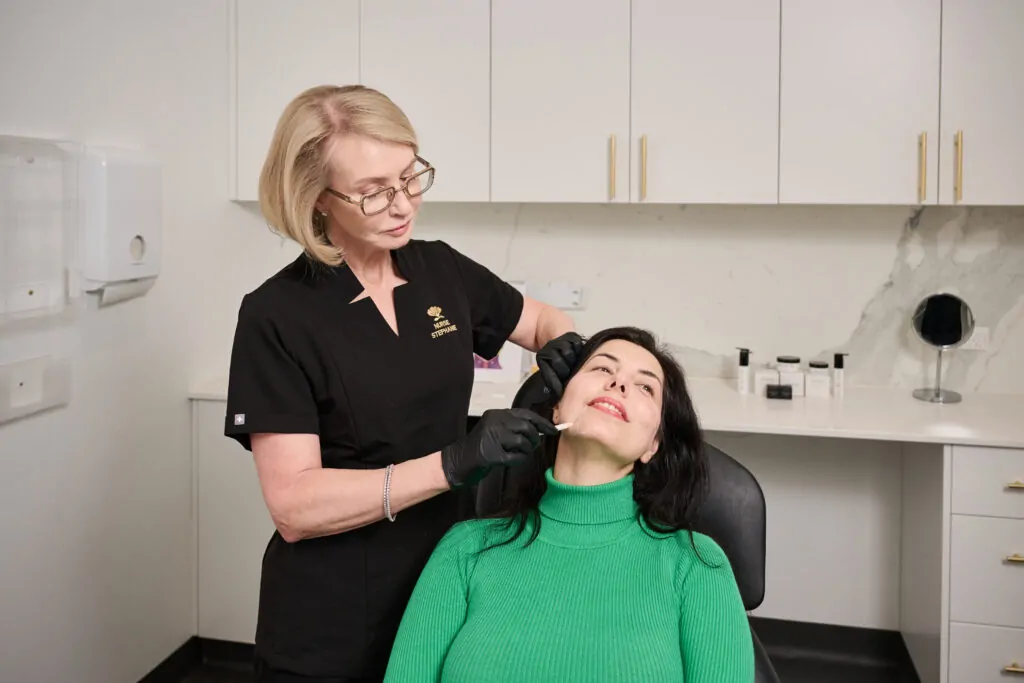
During the appointment. Around 30 to 45 minutes, plus 20 to 30 minutes for topical anaesthetic to take effect. Most people describe the injections as tolerable rather than comfortable.
Immediately after. Small raised bumps at each injection point. These are the product sitting in the skin before it disperses. Redness and mild swelling are common.
Day one to two. Bumps usually settle within 24 hours. Swelling generally resolves within 48. Bruising, if it happens, is at its most obvious around now.
Day three to seven. Bruising fades, and under the eyes it can take the full week or slightly longer. Most people are back to normal appearance in this window.
Week two to three. Some people notice the first changes in skin texture and hydration. Others notice nothing yet, which is also normal. Session two usually falls around here.
After the third session. The course is complete, but the process is not. The collagen-related changes continue developing.
Three to six months. This is when the remodelling effects generally become apparent, and it is the point at which a fair assessment can be made. If you are going to take your own photographs, take a baseline before session one and repeat at the same time of day, in the same light, at the same angle.
Six to twelve months. Maintenance is commonly discussed in this window. The interval varies considerably depending on skin condition, age, sun exposure and lifestyle.
Downtime and aftercare
Most people return to normal activities the same day, though you may want to keep the first 24 hours free of anything social while the bumps settle.
First 24 hours: no makeup over the injection points, and avoid touching or massaging the area unless instructed otherwise.
First 48 hours: avoid strenuous exercise, saunas, hot yoga, swimming pools and alcohol. All of these increase swelling and bruising.
First few days: avoid active skincare such as retinoids and acids, and keep the treated area out of the sun.
Written aftercare instructions are provided at your appointment, and you can ring the clinic between appointments if something concerns you.
Our post on bruising after cosmetic treatment covers the practical side in more detail.
Side effects, and what is not normal
Common and expected: small bumps at injection points, redness, mild swelling, tenderness, itching and bruising, generally settling within 24 to 48 hours, with bruising up to a week.
Less common: prolonged swelling, lumpiness that takes longer than expected to settle, pigmentation changes at injection points particularly in darker skin types, and temporary sensitivity.
Uncommon but more serious: infection at an injection site, allergic or hypersensitivity reaction including reactions related to the salmon-derived component, granuloma formation, and vascular complications, which are a recognised risk of any facial injection.
Contact the clinic immediately on (08) 9389 9099 if you develop increasing pain, spreading redness, heat, discharge, skin colour changes, vision changes or any effect you were not told to expect. If you cannot reach us and you are unwell, seek urgent medical care. Not normal is not something to wait out.
Does Rejuran actually work?
The fair answer is that the evidence supports it for what it is designed to do, and the evidence base is still young.
A systematic review published in the Journal of Cosmetic Dermatology in 2025 synthesised the literature on polynucleotides in aesthetic medicine and reported improvements in wrinkle-related measures, skin texture and elasticity across several studies, with a low rate of side effects. A 2026 systematic review in Cureus identified seven randomised trials involving 183 participants across skin rejuvenation, scar prevention and wound healing, reporting improvements in wrinkle-related outcomes, scar quality and patient-reported satisfaction, and no serious treatment-related adverse events across the included studies.
The caveats are consistent across both reviews, and we would rather state them than leave them out. Neither review is specific to a single product brand. Sample sizes are small. Protocols, products and comparators differ between studies. Follow-up is short. That supports polynucleotides as a reasonable option for skin quality, and it does not support treating them as a replacement for procedures that address volume loss, significant laxity or pigment.
What changes your result
Where you start counts for more than anything else. If the main concern is texture, there is usually room to move. If it is significant laxity, a polynucleotide treatment may not be the right tool, and that is better to hear at consultation than after three sessions.
Sun exposure works against you throughout. So does smoking. Both affect collagen directly, and neither is a small factor over a three-to-six-month remodelling period.
Completing the course matters. One session is not a trial of the treatment. It is a third of one.
And age, general health, medications and skin condition all influence how your skin responds. Results vary between individuals, and no practitioner can promise a specific outcome.
Why choose Absolute Cosmetic for Rejuran in Perth
A doctor-led practice operating in Perth since 1996. Absolute Cosmetic is led by Medical Director Dr Glenn Murray (MED0001196978), MBBS, FRACGP, a registered medical practitioner with specialist registration in general practice. Dr Murray has worked in cosmetic medicine since 1996, owns and operates the clinics with Director of Nursing Stephanie Murray (NMW0001544535), provides medicolegal and second opinion work, and holds a day hospital licence from the Western Australian Health Department. He does not hold specialist registration in surgery and does not use the title surgeon. His background is on his practitioner profile.
Injectable treatments overseen by a Director of Nursing with more than 30 years in healthcare. Stephanie Murray (NMW0001544535), Registered Nurse (Division 1), general registration, co-founded the practice and leads our nursing team. Our nurses are mentored through shadowing, hands-on training and structured supervision rather than a single product-training day. Her profile is here.
Practitioners who train other practitioners. Stephanie Murray (NMW0001544535) and Dr Glenn Murray (MED0001196978) established the Cosmetic Injector Institute to provide structured training to nurses in the cosmetic industry. Our team undertakes regular education in facial anatomy, product knowledge, complication recognition and management, and patient safety.
Continuity across a course. Several of our nurses have been with the practice since its early years. For a treatment delivered over three sessions and reviewed across months, seeing the same practitioner is not a trivial detail.
Registration you can verify. Both registration numbers above can be checked on the AHPRA public register. We would encourage you to check any practitioner you are considering, anywhere.
Full treatment information, including formulations, risks and cost, is on our Rejuran Perth page. To arrange a consultation, call (08) 9389 9099 or book online.
Further reading
- Rejuran Perth treatment information
- Why before and after photos matter
- Bruising after cosmetic treatment
- Why do I need a consultation before my treatment?
Medical references
- Lampridou S, Bassett S, Cavallini M, Christopoulos G. The Effectiveness of Polynucleotides in Esthetic Medicine: A Systematic Review. Journal of Cosmetic Dermatology. 2025;24(2):e16721. PubMed
- Alshehri AF. Polynucleotides and Polydeoxyribonucleotides for Skin Rejuvenation, Postoperative Scar Prevention, and Wound Healing: A Systematic Review of Randomized Clinical Trials. Cureus. 2026. PubMed Central
- Ahpra and the National Boards. Guidelines for advertising higher risk non-surgical cosmetic procedures, issued 2 September 2025
- Ahpra. Thinking about cosmetic injectables
- Healthdirect Australia. Guide to cosmetic surgery
Disclaimer: This article is general information only and is not a substitute for personalised medical advice. Individual results vary and no outcome can be guaranteed. All procedures carry risks, which should be discussed with a qualified practitioner who has assessed your circumstances.