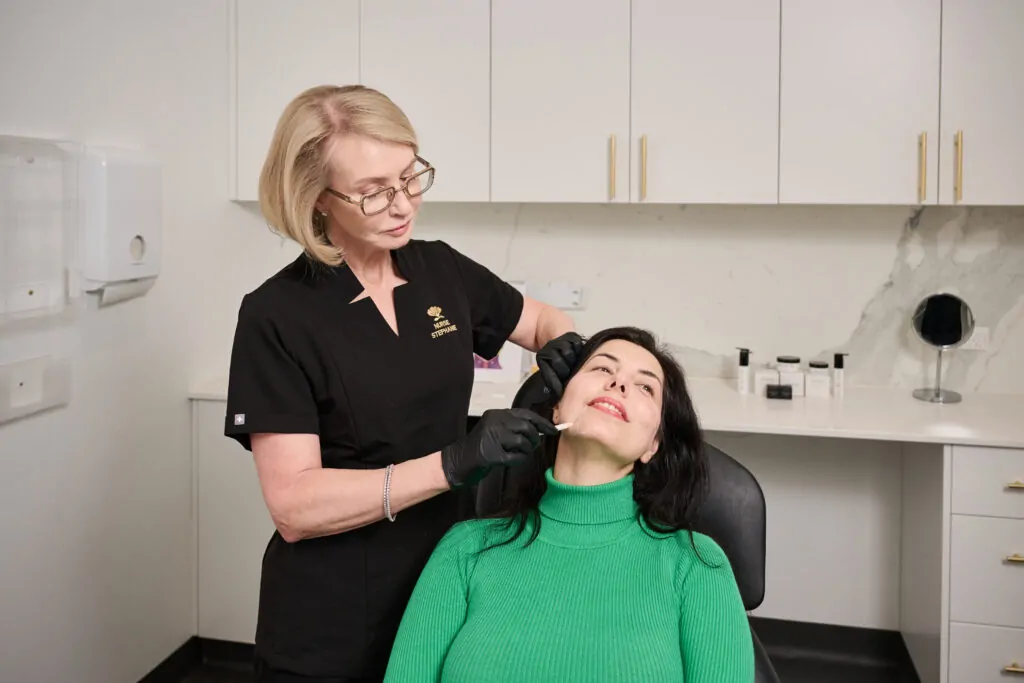
The under-eye area is the single most common reason people ask us about Rejuran®, and it is also the area where expectations and reality part company most often.
Part of the problem is that “dark circles” is not one condition. It is a description of how something looks, and at least four different things can produce that look. Some of them respond to a polynucleotide injectable. Some of them do not respond at all, and no amount of product will change that. Working out which one you have is the entire job of the consultation, and it is worth understanding before you book anything.
This article covers what the under-eye formulation actually does, what the published research supports, what a course involves, and where Rejuran® is the wrong answer.
The short version
Is Rejuran good for under eyes? It can help where the concern is skin quality, so crepey texture, fine lines and thin, translucent skin. It does not lighten pigment directly and it does not fill hollows.
Will it fix my dark circles? Only if skin thinness is the main thing causing them. If the cause is pigment, visible blood vessels or a hollow casting a shadow, a different approach is needed, and sometimes a combination.
How long does it last under the eyes? It is not permanent. The material breaks down in the body over time. Maintenance is usually talked about somewhere in the six to twelve month range, and that gap varies a lot from one person to the next.
What does it cost in Perth? At Absolute Cosmetic, Rejuran® Eyes starts from $650 per session. A course is usually three sessions, so budget on that basis.
Does it bruise? Yes, more than most areas. Plan around any event you have coming up.
Why the under-eye area behaves differently
Eyelid skin is about half a millimetre thick. Nowhere else on the body is thinner. It carries barely any oil glands, less supporting collagen than the cheek does, and it sits directly over a dense network of small blood vessels.
Most of what happens in this area traces back to that. As collagen drops away with age, skin that thin turns translucent and whatever sits beneath it begins to show. With so little structure holding it, it creases. And because the vessels run close to the surface in loose tissue, it swells and bruises with very little provocation.
It is also why treatments designed for the cheek are not simply scaled down for the eye. Rejuran® Eyes, sold as Rejuran i, is a lower-viscosity formulation made for this tissue specifically. Using a heavier formulation here would be the wrong choice.
Four causes of dark circles, and which ones matter here
Clinicians tend to sort periorbital dark circles into four contributors. Most people have more than one of them at work.
Pigmentary. Excess melanin in the under-eye skin, brown or grey in tone. It looks the same after a good night of sleep as it does after a bad one. It often runs in families, and it turns up more often in medium and deeper skin tones. Rough self-check: lift the skin gently. If the colour moves with it and barely changes, pigment is probably part of the picture.
Vascular. Blue, purple or reddish tones from blood vessels visible through thin skin. Typically worse in the morning, after poor sleep, or during allergy season. A rough self-check: press gently. If the colour briefly lightens, there is a vascular element.
Structural. A hollow at the tear trough, the result of volume and bone changing over the years. The hollow throws a shadow, and the shadow reads as darkness. Rough self-check: tilt your head towards a light. If the darkness lifts as the angle changes, you are looking at shadow rather than colour.
Skin translucency. Thinning, crepey skin that lets everything underneath show through more than it used to, and creases when you smile.
These self-checks are a starting point for the conversation, not a diagnosis. Most people have a combination, and the proportions matter for deciding what to do.
Rejuran® is aimed at the fourth of those. By supporting collagen in the dermis, the intention is to improve the quality and thickness of the skin itself. Where thin, translucent skin is the main driver, that can change how the area looks. Where the main driver is melanin or a hollow, it will not.
Pigment usually needs a pigment-directed approach. A hollow usually needs volume. If pigmentation is the concern, our pigmentation page sets out the options there. Where the problem is loose lower eyelid skin or fat pads pushing forward as bags, the honest answer is often surgical rather than injectable, and eyelid surgery is the page to read.
What Rejuran® Eyes is
Rejuran® is a polynucleotide injectable. The polynucleotides are DNA fragments extracted and purified from Korean chum salmon, processed into a sterile gel of controlled fragment size. Once placed in the dermis, the material acts as a scaffold within the tissue and provides a substrate that fibroblasts, the collagen-producing cells, can respond to.
Rejuran i is the periorbital formulation, with a lower viscosity suited to thin eyelid skin. In Australia it is included in the Australian Register of Therapeutic Goods as a Class III medical device under ARTG ID 412631, sponsored by K Bridge Medical Pty Ltd and manufactured by PharmaResearch Co Ltd. ARTG inclusion means the product has been assessed for safety and quality before it can lawfully be supplied here. It is not a statement about the cosmetic result you personally will get.
Full detail on the formulations, risks and process is on our Rejuran Perth treatment page.
What the research actually supports
This is where we would rather be specific than enthusiastic.
The study quoted most often here is a phase III randomised, double-blind, matched-pairs trial published in the Journal of Korean Medical Science in 2014, which set a purified polynucleotide product against a hyaluronic acid filler for crow’s feet.
Two things follow from that, and both matter.
First, the periorbital evidence that does exist is about crow’s feet and fine lines, which is a skin quality outcome. That is consistent with what the treatment is designed to do.
Second, nothing comparable has been published showing that polynucleotides lighten pigmented dark circles or correct a tear trough hollow. Presenting Rejuran® as a treatment for dark circles in general therefore goes further than the evidence does. A systematic review of polynucleotides in aesthetic medicine lands in much the same place: the skin quality signal is reasonable, but the studies behind it are small, run to different protocols, and follow people for a short time.
What a course involves
A typical under-eye course is three sessions of around 1ml each, spaced two to three weeks apart.
Your appointment runs 30 to 45 minutes plus numbing time. Topical anaesthetic is usually applied and left to work for around 20 to 30 minutes. The product is then placed through a series of small injections across the treatment area with a fine needle, or in some cases a cannula.
You will have small raised bumps at each injection point immediately afterwards. This is the product sitting in the skin before it disperses, it is expected, and it generally settles within 24 hours.
As for timing of any visible change, this is a gradual treatment. Some people notice differences in texture and hydration from around two weeks. Collagen-related change generally develops over three to six months following a completed course. It is not a treatment that produces a visible change within days.
Results vary between individuals and depend on your skin, your age, your general health, sun exposure and how your skin responds. No practitioner can promise a specific outcome.
About the bruising
This deserves its own section because it is the most common complaint we hear, and it is almost always a scheduling problem rather than a clinical one.
The under-eye area bruises more readily than anywhere else on the face. Pinpoint bruising is common, and a bruise there can take up to a week to resolve, sometimes a little longer. It can also track downward onto the upper cheek as it fades.
Practical implications: do not book this in the week before a wedding, a holiday or anything photographed. Tell your practitioner about any blood-thinning medication, fish oil or anti-inflammatory use, because these are discussed as part of your assessment. And if you are having three sessions two to three weeks apart, map the whole course against your diary at the start rather than session by session.
How it compares for under-eye concerns
| Approach | Best suited to | Timing of change | What it does not do |
|---|---|---|---|
| Rejuran® Eyes | Thin, crepey skin and fine lines | Gradual, weeks to months | Does not lighten pigment or fill hollows |
| Dermal filler in the tear trough | Structural hollowing and shadow | Immediate | Does not improve skin quality or pigment |
| Pigment-directed treatments | Melanin-driven darkness | Weeks, over a course | Does not thicken skin or fill hollows |
| Laser skin treatments | Texture and some pigment | Weeks to months | Requires care around the eye, more downtime |
| Lower eyelid surgery | Excess skin and fat pads causing bags | Once healed | Does not treat pigment directly |
There is no single best injectable for the under-eye area, despite how often that question gets asked. The right answer depends on which of the four contributors is dominant in your case, and for a lot of people the sensible plan addresses more than one.
When Rejuran® is not appropriate
Tell your practitioner before booking if you have a known fish or seafood allergy. Rejuran® is derived from salmon DNA, and this is the first thing to raise.
We do not treat during pregnancy or breastfeeding. Active skin infection, inflammation or active acne in the treatment area, a history of keloid scarring, some autoimmune conditions, current anticoagulant use and recent treatments in the same area all need discussion and may change or rule out the plan.
Beyond the medical picture, it is also not the right treatment if your main concern is a hollow or pigment, if you need a change within days, or if you are not able to commit to a course and a review. Your practitioner will tell you when a different treatment, or no treatment, is the better answer.
Risks
Every injection around the eye carries risk. Read this part before you book, not after.
Common and expected: small bumps where the needle went in, along with redness, swelling, tenderness and bruising. Most of that settles inside 24 to 48 hours. Bruising can run to a week.
Less common: prolonged swelling, lumpiness that takes longer than expected to settle, and pigmentation changes at injection points, particularly in darker skin types.
Uncommon but more serious: infection, allergic or hypersensitivity reaction including reactions related to the salmon-derived component, granuloma formation, and vascular complications, which are a recognised risk of any facial injection.
If you develop increasing pain, spreading redness, heat, discharge, skin colour changes or any change in vision after treatment, contact the clinic immediately on (08) 9389 9099. If you cannot reach us and you are unwell, seek urgent medical care.
What it costs in Perth
At Absolute Cosmetic, Rejuran® Eyes starts from $650 per session. A course is usually three sessions, so the number to budget against is the course total, from $1,950, rather than the single session price.
Prices are current at the time of publication and are a guide. Your final cost is confirmed at consultation once the formulation, volume and number of sessions are decided. A $90 deposit applies to online bookings. Cosmetic injectable treatments do not attract a Medicare rebate or a private health insurance benefit.
Why choose Absolute Cosmetic for Rejuran in Perth
A doctor-led practice operating in Perth since 1996. Absolute Cosmetic is led by Medical Director Dr Glenn Murray (MED0001196978), MBBS, FRACGP, a registered medical practitioner with specialist registration in general practice. Dr Murray has worked in cosmetic medicine since 1996, owns and operates the clinics with Director of Nursing Stephanie Murray (NMW0001544535), and holds a day hospital licence from the Western Australian Health Department. He does not hold specialist registration in surgery and does not use the title surgeon. His background is on his practitioner profile.
Injectable treatments overseen by a Director of Nursing with more than 30 years in healthcare. Stephanie Murray (NMW0001544535), Registered Nurse with general registration, co-founded the practice and leads our nursing team. Her profile is here.
Practitioners who train other practitioners. Stephanie Murray (NMW0001544535) and Dr Glenn Murray (MED0001196978) established the Cosmetic Injector Institute to provide structured training to nurses working in cosmetic medicine. Our own nurses are mentored through shadowing, hands-on training and supervision, and the team undertakes regular education in facial anatomy, complication recognition and management, and patient safety. Periorbital injecting depends on that anatomical knowledge.
Assessment before product. Because the under-eye area has four possible contributors and only some respond to polynucleotides, every Rejuran® appointment starts with an assessment of what is actually driving your concern. Our practitioners decline treatment where they do not believe it is in a patient’s interests.
Registration you can verify. Both registration numbers above can be checked on the AHPRA public register. We would encourage you to check any practitioner you are considering, anywhere.
Clinics across Perth and regional WA. Five Perth metropolitan clinics at Nedlands, Innaloo, Applecross, Joondalup and Perth CBD, plus regional clinics, so a three-session course does not depend on one location.
To arrange a consultation, call (08) 9389 9099 or book online.
Any surgical or invasive procedure carries risk. Results differ from one person to the next, shaped by things like genetics, age, diet, lifestyle and general health, and no outcome can be guaranteed. This article is general information only; it is not medical advice and does not create a doctor-patient relationship. The content is intended for readers aged 18 and over.
Further reading
- Rejuran Perth treatment information
- Bags and dark circles under the eyes
- Under-eye wrinkles
- Treatment options for skin laxity around the eye
Medical references
- Pak CS, Lee J, Lee H, et al. A Phase III, Randomized, Double-Blind, Matched-Pairs, Active-Controlled Clinical Trial and Preclinical Animal Study to Compare the Durability, Efficacy and Safety between Polynucleotide Filler and Hyaluronic Acid Filler in the Correction of Crow’s Feet. Journal of Korean Medical Science. 2014;29(Suppl 3):S201-S209. PubMed Central
- Lampridou S, Bassett S, Cavallini M, Christopoulos G. The Effectiveness of Polynucleotides in Esthetic Medicine: A Systematic Review. Journal of Cosmetic Dermatology. 2025;24(2):e16721. PubMed
- Friedmann DP, Goldman MP. Dark circles: etiology and management options. Clinics in Plastic Surgery. 2015;42(1):33-50. PubMed
- Cleveland Clinic. Dark circles under the eyes
- Ahpra and the National Boards. Guidelines for advertising higher risk non-surgical cosmetic procedures
- Ahpra. Thinking about cosmetic injectables