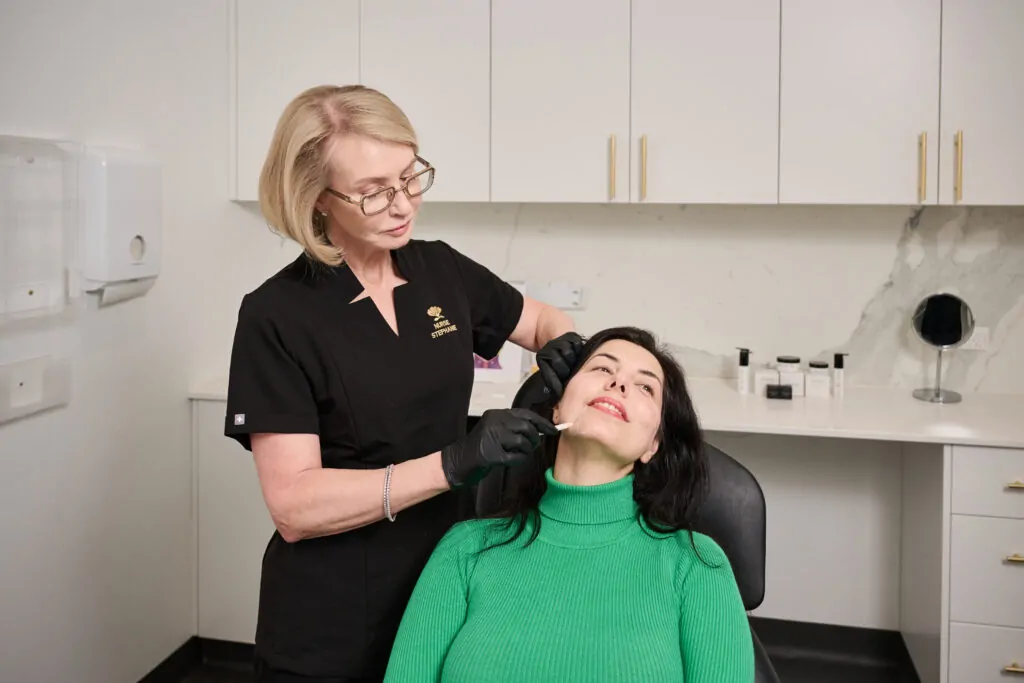
In Perth, laser skin resurfacing generally runs from about $450 a session for nurse-performed Pixel fractional treatment, right up to $4,400 and beyond for Erbium resurfacing at Absolute Cosmetic’s Nedlands day hospital. A few things push that number up or down. The biggest is the device itself and how deep it works, though the size of the area being treated matters too, and so does the number of sessions your skin ends up needing.
Written by the Absolute Cosmetic content team. Medically reviewed by Dr Glenn Murray (AHPRA registration MED0001196978), Medical Director. Last updated August 2026.
The short answer: what laser skin resurfacing costs in Perth
Pricing here works per session and per area, and the range is wide simply because these treatments operate at very different depths. At the lighter end, Pixel fractional laser resurfacing starts at $450 per session with one of our nurses and $700 with a doctor. Fractional DOT CO2 laser therapy starts from $850 for a half face and from $1,200 for a full face. Erbium laser skin resurfacing starts from $4,400, and that excludes the theatre fee, post-procedure creams and prescribed medications, because it is performed under sedation in our accredited day hospital.
Treat these as indicative starting figures rather than firm quotes. Prices are current as of August 2026 and confirmed in writing at consultation. The full Absolute Cosmetic pricing list carries the current schedule, and payment plan options are set out separately.
Price ranges by device and treatment area
| Device | Typical area | Indicative price per session (AUD) | Typical session count |
|---|---|---|---|
| Pixel fractional (Er:YAG), nurse-performed | Face | From $450 | 3 to 4 |
| Pixel fractional (Er:YAG), doctor-performed | Face, décolletage or hands | From $700 | 3 to 4 |
| DOT CO2 fractional | Half face | From $850 | 1 to 3 |
| DOT CO2 fractional | Full face | From $1,200 | 1 to 3 |
| Erbium resurfacing, day hospital under sedation | Face, or face with neck and chest | From $4,400, excluding theatre fee and post-procedure items | Usually 1 |
Prices current as of August 2026. Individual quotes are provided at consultation after assessment.
Why two Perth clinics can quote very different prices for “laser resurfacing”
“Laser resurfacing” is not one procedure, so two quotes that look comparable often are not. A light fractional pass primarily works on the surface, whereas a deep ablative treatment removes layers of skin and must be performed in a controlled clinical setting. They are really two different categories of things, and the tissue involved, the recovery and the level of risk all differ.
Most of the gap comes down to a handful of things. What class of device it is and how deep it goes, who is actually operating it (a nurse or a doctor), and whether the quote already includes anaesthetic, theatre time and dressings or leaves them to be added on afterwards. Follow-up reviews and post-procedure products can be bundled in or charged separately as well. Before you compare two prices, it is worth asking each clinic for the all-inclusive figure in writing.
What you are actually paying for
The price on a resurfacing quote reflects far more than the few minutes the handpiece actually spends on your skin.
Consultation and skin assessment. The first question is always whether resurfacing suits you at all, which means going through your skin type, medical history, medications, any history of cold sores, recent sun exposure, and what it is you actually want to change. At Absolute Cosmetic, an Observ 520X skin analysis is used to assess pigment and vascular patterns beneath the surface, which informs device selection and settings.
Device time. A Pixel session on the face usually takes about 15 to 30 minutes, and longer if a larger area is being treated. An Erbium procedure takes roughly an hour, with about two hours of recovery afterwards before you are discharged.
Anaesthetic. For fractional treatments, we use a topical numbing cream as standard, with nitrous oxide gas on hand if you want it for comfort. Erbium resurfacing, by contrast, is done under neurolept sedation in our day hospital, and that is where a large part of the price difference comes from.
Post-procedure products. Aftercare for Erbium involves vinegar washes and Dermeze ointment applied 4 times a day, whereas fractional treatments require only a bland moisturiser and strict sun protection. Some clinics fold these into the price, and others do not.
Reviews and aftercare. With Erbium, you return to our Nedlands clinic the following day for a day-one review, and a 24-hour on-call service runs alongside it. That aftercare is built into what you pay, and it is often what prevents a small issue from becoming a bigger one.
The three resurfacing options at Absolute Cosmetic, and how the cost differs
We work with three different resurfacing devices, and they really are not interchangeable. The right one depends on how deep the concern sits, your Fitzpatrick skin type, and how much recovery time you can realistically take. Broadly, the cost tracks depth. The deeper treatments tend to need fewer sessions, but each one costs more and asks a good deal more of you during recovery. Our guide to choosing the right laser treatment for your skin covers device selection in more detail.
Pixel fractional laser resurfacing (Er:YAG)
Pixel is a fractional Er:YAG (erbium-doped yttrium aluminium garnet) laser. In practice, that means the beam is broken up into a grid of tiny dots, so treated columns of skin end up sitting next to untreated ones, which is what keeps the recovery shorter than a full ablative pass. It tends to suit mild to moderate texture concerns, fine lines, sun damage, and some pigmentation, and is usually done as a course of three to four sessions spaced four to eight weeks apart, though many patients are happy after two. That mix of a lower cost per session and downtime you can work around is why it is the most common way people start with resurfacing in Perth. It is available at our Nedlands and Applecross clinics, and the Pixel fractional laser page sets out the full protocol.
Erbium laser skin resurfacing
Erbium resurfacing is the deepest option we offer, and on our site it sits under surgical laser and light procedures. The laser targets water in the tissue and vaporises the outer layers in a controlled way, one layer at a time, leaving less residual heat than CO2. We use it for lines, wrinkles, sun damage, uneven pigment and scarring, on the face, around the lips and eyes, and on the neck and hands. Because it is carried out under sedation in our Nedlands day hospital, you will need a GP referral before consulting Dr Murray, and a mandatory seven-day cooling-off period applies. It carries the highest cost per session of the three and the longest recovery time, though it is usually just a single treatment. Details are on the Erbium laser skin resurfacing page.
DOT CO2 fractional laser
DOT is short for Dermal Optical Thermolysis. It is a fractional carbon dioxide laser, and in terms of depth, it sits between a Pixel treatment and a full Erbium treatment. We tend to recommend a CO2 laser for deeper wrinkles, established acne scarring and heavier sun damage, the sort of thing a lighter device simply will not reach far enough to shift. You will generally see more downtime than with Pixel and a higher cost per session, over somewhere between one and three sessions, depending on the settings used and what is being treated. Doctor-level settings are priced from $800, half-face from $850, and full-face from $1,200. The DOT CO2 fractional laser page explains what it does and does not address. If pigment rather than texture is your main concern, the Enlighten III pico laser may be the better conversation.
Side-by-side comparison
| Pixel fractional (Er:YAG) | DOT CO2 fractional | Erbium resurfacing | |
|---|---|---|---|
| Depth | Superficial to moderate, fractional | Moderate to deep, fractional | Deepest, fully ablative |
| Best suited to | Texture, fine lines, sun damage, some pigmentation | Deeper wrinkles, acne scarring, marked sun damage | Established lines, wrinkles, sun damage, scarring |
| Typical downtime | 1 day to 1 week | Several days to around a week | 7 to 10 days to heal, redness beyond that |
| Typical sessions | 3 to 4 | 1 to 3 | Usually 1 |
| Setting | Clinic | Clinic | Accredited day hospital, under sedation |
| Relative cost per session | Low | Moderate | High |
How many sessions will I actually need?
Most people end up going one of two ways: a single deep treatment, or a course of three to four lighter ones. What tends to surprise patients is how close the totals can end up once everything is added in. Four nurse-performed Pixel sessions at $450 work out to about $1,800, and a single full-face DOT CO2 treatment from $1,200 lands in much the same territory. Erbium sits well above both of those, but it is generally a one-off.
So the cheapest number is rarely the one to chase. It really depends on your skin, how deep the concern goes, and how much recovery you can take in one hit. Can’t take a week off client-facing work? A Pixel series is probably a better fit, even with the appointments spread over three or four months. Got deeper wrinkles or older acne scarring? Treating it properly once can actually cost you less than paying over and over for a device that was never going to reach it. Session numbers are estimated at consultation and reviewed as your skin responds.
Downtime is part of the cost
It is worth setting aside time away from work in your budget as a specific line item, because, in practical terms, that is what it is.
Straight after Pixel, the treated skin shows fine white dots, then turns red and warm, much like a sunburn. For the first couple of days, you keep it lightly moist, and a bit of peeling or scabbing is nothing to worry about. Makeup can go back on once the skin has healed, which usually takes about 5 days. All up, the downtime is anywhere from a day to a week, and it runs longer with stronger settings.
DOT CO2 asks a bit more of you: several days of noticeable redness and swelling, a bronzed look for a while, and then peeling as the surface turns over.
Erbium is the big one. You are sedated for it, so you will need a responsible adult to drive you home and stay overnight, and you come back to Nedlands the next day. The skin usually heals over seven to 10 days, makeup is generally fine again at about the two-week mark, and some redness can linger past that. Set aside seven to 10 days at home at a minimum. Recovery really does vary from person to person, and things like age, genetics and lifestyle all play a part.
Skin type matters: resurfacing on deeper skin tones
Your skin type drives the whole plan here, not just the price. Fitzpatrick skin types IV to VI carry a higher risk of post-inflammatory hyperpigmentation, where skin responds to injury by producing patchy excess pigment. It’s a manageable risk, but only if you plan for it on purpose instead of hoping it won’t show up.
So a few things change. Device choice is the big one. Lasers that target pigment are often a poor fit for darker skin, whereas fractional resurfacing that targets water in the tissue usually works well. Settings get dialled back too: fewer passes, lower density. You’ll often prime the skin with a prescribed pigment-regulating regimen first, sometimes keep it going afterwards, and space the sessions further apart. And sun avoidance? That stops being optional.
Even if your skin type has kept you from resurfacing elsewhere, it is still worth getting properly assessed. The Fitzpatrick classification is the start of that conversation, not the end of it, and any history of melasma, keloid scarring or pigment change after a previous injury is relevant information to bring with you.
Timing your treatment in the Perth climate
In practice, autumn and winter are the sensible seasons for resurfacing in Perth. For much of the summer, the UV levels here are in the extreme range, and skin that is still healing is unusually vulnerable to them. If treated skin catches the sun mid-recovery, it is more prone to pigment changes, which is exactly what you were trying to head off in the first place.
Daily broad-spectrum SPF 50+, a hat and genuinely seeking out shade are all part of the treatment itself, not some optional extra you tack on afterwards. Cancer Council WA’s SunSmart guidance is a sensible reference for what constitutes adequate protection. Got a Bali trip or a Margaret River summer coming up? Book the laser in at the other end of the year instead. We cover the seasonal logic in our post on why winter may be a better time for cosmetic treatments.
Who is allowed to operate a laser in Western Australia?
In Western Australia, the high-powered lasers used for cosmetic work are tightly regulated. A licence and registration are required to use Class 3B or Class 4 lasers for cosmetic treatments under the state’s radiation safety framework, administered by the Radiological Council of WA, and intense pulsed light devices are not currently regulated under the same Act. For cosmetic laser procedures other than hair removal, patients must have an in-person consultation with a medical practitioner or nurse practitioner to check for skin cancers or other underlying conditions.
All of that hands you a reasonable set of questions to put to any clinic. Is the device itself registered and the premises licensed? Which medical practitioner set the protocols the operator is following, and are they actually on site? What training has the person holding the handpiece had on this particular device? When was it last serviced, and is it listed on the Australian Register of Therapeutic Goods? If a clinic cannot answer them fairly quickly, that in itself tells you something worth knowing.
Risks and possible complications
Laser resurfacing is a genuine medical procedure, and it carries real risks. Careful assessment, sensible device selection and good aftercare keep those risks in check, but they do not remove them, and the treatment is not right for everyone.
The risks that have been reported include prolonged redness and swelling, infection, pigment change in either direction (darker or lighter, and occasionally lasting), blistering, scarring, cold sores flaring up again, and eye injury if protective eyewear is not worn properly. There is also a chance of an incomplete result, in which the improvement falls short of what you hoped for, and more treatment is needed. The deeper treatments carry more of these risks rather than fewer, which is one of the reasons they are done in a controlled setting. Any severe swelling or a fever is a reason to contact the clinic straight away. Our full risks and complications information sets out what to watch for, and we go through it before you consent to anything.
Is laser resurfacing worth it?
That really comes down to what it is you are hoping to change. It works on the surface and the upper layers of the skin, so think texture, fine lines, sun damage, uneven pigment and some kinds of scarring. Results differ from one person to the next.
What resurfacing will not do is lift anything. It will not reposition sagging tissue along the jawline or under the chin, nor will it replace lost facial volume. If loose skin is the main concern, Ultraformer skin tightening or a mini facelift are different conversations at different price points. For established acne scarring, resurfacing is usually part of a plan rather than the whole plan. Documented outcomes are in our before-and-after gallery.
Why choose Dr Murray for laser skin resurfacing in Perth
The practitioners. Our Medical Director, Dr Glenn Murray (AHPRA registration MED0001196978), MBBS, FRACGP, MIT AI (Health) Cert., is a registered medical practitioner and Specialist General Practitioner with specialist registration in general practice, and has 30 years of experience in aesthetic medicine. He performs Erbium laser skin resurfacing in our licensed day hospital and heads up a multidisciplinary team across five Perth clinics. Our Director of Nursing, Stephanie Murray (AHPRA registration NMW0001544535), leads the nursing team and sets clinical standards, including the in-house training program that every nurse completes before operating any laser device. You can verify both registrations on the AHPRA public register, and read more on our team page. Dr Murray’s professional profiles are also listed on RealSelf and LinkedIn.
Professional memberships. Dr Murray is a member of the Cosmetic Physicians College of Australasia, the Australian College of Cosmetic Surgery and Medicine, the International Master Course on Ageing Skin, the European Academy of Aesthetic Medicine and Surgery and the International Board of Aesthetic Medicine and Surgery. Full list on our memberships and awards page.
Where we treat. We run five full-time Perth clinics, in Nedlands, Joondalup, Perth City at Raine Square, Applecross and Innaloo. Pixel fractional resurfacing is offered at Nedlands and Applecross, and Erbium resurfacing takes place in the accredited day hospital inside our Nedlands clinic. Our practitioners also travel to Mandurah, Bunbury, Geraldton, Kalgoorlie, Karratha and Esperance, with Busselton opening before long. If you live outside the metro area, you can do an initial consultation over Skype, FaceTime or WhatsApp. All clinic locations are listed on our site.
How consultations work. Every plan begins with an individual assessment of your skin and medical history, a proper discussion of the risks, the recovery and the alternatives, and written information for you to take home. Treatments are carried out in medically supervised clinic settings by appropriately qualified, AHPRA-registered practitioners. For Erbium resurfacing, you will need a GP referral, and a seven-day cooling-off period applies. Use that time, read the risks and complications information, and seek a second opinion.
Frequently asked questions
How much does laser skin resurfacing cost in Australia?
It varies quite a bit depending on the device and how deep it works. In Perth, the lighter fractional treatments start from around $450 per session, fractional CO2 from $850 for a half-face, and a deep ablative Erbium treatment from $4,400, on top of theatre and post-procedure costs. The better move is to ask for an all-inclusive written quote after your consultation, rather than comparing advertised starting prices.
How many laser resurfacing sessions do I need?
With a lighter fractional treatment such as Pixel, you are usually looking at three to four sessions spaced four to eight weeks apart, though some people are happy after two. Fractional CO2 tends to be one to three sessions, and a deep Erbium treatment is usually just the one. The exact number is estimated at your consultation and then reviewed as your skin responds.
How long does it take to recover from laser resurfacing?
That comes down to depth. Downtime after Pixel ranges from a day to a week, while fractional CO2 usually results in several days of redness, swelling, and peeling. Erbium tends to heal over 7 to 10 days, with makeup generally possible around the 2-week mark, though some redness may linger afterwards. Recovery is different for everyone.
What is the difference between CO2 and Erbium laser resurfacing?
Both remove skin layers, but they do so differently. A CO2 laser leaves more residual heat in the surrounding tissue, which helps with collagen remodelling but prolongs redness. Erbium (Er:YAG) targets water more precisely and spreads less heat, so removal occurs in a controlled, layer-by-layer fashion. Which one fits you is determined during the consultation, not by the device name on its own.
Can fractional laser be used on darker skin tones?
Often it can, as long as it is done carefully. Fractional resurfacing aimed at water rather than pigment suits many darker skin types, unlike devices that are drawn to melanin. Fitzpatrick types IV to VI do carry a higher risk of post-inflammatory hyperpigmentation, so the settings are kept more conservative, and it is common to prepare the skin with a pigment-regulating regimen beforehand. Suitability is always assessed on an individual basis.
Does laser resurfacing help acne scarring?
It can help with certain scar types by removing surface layers and prompting the skin to remodel collagen, which may smooth surface irregularities. There are limits to how deep it can safely go, so deeper or ice-pick scarring often requires extra sessions or a combined approach, and any active acne is usually settled first. Read more on treating acne and preventing scarring.
Any surgical or invasive procedure carries risk. Results differ from one person to the next, shaped by things like genetics, age, diet, lifestyle and general health, and no outcome can be guaranteed. This article is general information only; it is not medical advice and does not create a doctor-patient relationship. The content is intended for readers aged 18 and over.
Further reading
- Choosing the Right Laser Treatment for Your Skin: A Guide
- Does Laser Resurfacing Stop the Clock of Ageing?
- Why Winter May Be a Better Time for Cosmetic Treatments
- How Do I Get Rid of Acne and Prevent Scarring?
Medical references
- DermNet, Fractional laser treatment
- DermNet, Skin phototype (Fitzpatrick classification)
- DermNet, Post-inflammatory hyperpigmentation
- Radiological Council of Western Australia, specific requirements for laser registrations
- WA Department of Health, lasers and intense pulsed light sources
- WA Department of Health, cosmetic and beauty treatments
- Therapeutic Goods Administration, medical devices regulation
- AHPRA, cosmetic surgery hub
- Medical Board of Australia, guidelines for registered medical practitioners who advertise cosmetic surgery
- Cleveland Clinic, laser skin resurfacing
- Cancer Council WA, SunSmart guidance